Influence of Climatic Parameters on the Performance of Polycrystalline and Monocrystalline Silicon Photovoltaic Solar Modules: The Case of the City of Koudougou
Monocrystalline and polycrystalline silicon-based modules are commonly used in Burkina Faso, particularly in the city of Koudougou, to generate electricity. However, climatic parameters affect the performance of these modules. It is therefore necessary to conduct a comparative study between polycrystalline and monocrystalline silicon-based photovoltaic solar modules. The objective of this work is therefore to determine the module best suited to the city of Koudougou's climatic context. In this study, climatic parameters such as sunshine and temperature were considered. Thus, based on the mathematical model of a photovoltaic module, a simulation was carried out in the MATLAB/Simulink environment an experimental study of the two types of modules was conducted. The results obtained after the simulations and experiments were compared. Analysis of the results for the two module technologies shows that during the period of the day when the temperature is high, the polycrystalline silicon-based module performs better than the monocrystalline silicon-based module. However, during periods when the temperature is lower, the monocrystalline module performs better than the polycrystalline module. Considering the average daily power output for October 2024, it appears that the monocrystalline silicon-based module performs better than the polycrystalline silicon-based module. In general, monocrystalline modules offer better technical performance than polycrystalline modules in the climate of the city of Koudougou.
This is an Open Access article, distributed under the terms of the Creative Commons Attribution 4.0 International License (http://creativecommons.org/licenses/by/4.0/), which permits unrestricted use, distribution and reproduction in any medium or format, provided the original work is properly cited.
Photovoltaic Solar Module, Polycrystalline, Monocrystalline, Temperature, Irradiation, Modelling, Experimentation
1. Introduction
Currently, the exploitation of fossil fuels is one of the main causes of ozone layer depletion. It therefore contributes significantly to global warming. To address this issue, it is necessary to use new alternative energy sources that are environmentally friendly and sustainable.
Solar energy is a good alternative for reducing emissions of certain greenhouse gases. It is less polluting and available across the globe. Burkina Faso enjoys relatively high levels of sunshine, ranging from 3 kWh/m²/day to 7.5 kWh/m²/day, varying from south to north
[1]
M. Waongo, Z. Koalaga et F. Zougmore, «A guideline for sizing Photovoltaic panels across different climatic zones in Burkina Faso» IOP science (International Symposium on Electrical Arc and Thermal Plasmas in Africa (ISAPA)), vol. 29, pp. 1-15, 2012.
. Despite this high level of sunshine, studies show that many photovoltaic installations in Burkina Faso are either under-exploited or defective
[2]
K. Badza, M. Sawadogo, Y. M. Soro, «Environemntal impacts of a stand-alone photovoltaic system in sub-saharan Africa: A case study in Burkina Faso» ScienceDirect (Heliyon), vol. 10, pp. 1-11, 2024.
D. A Quansah, M. S Adaramola, L. D Mensaha, «Solar Photovoltaics in sub-Saharan Africa – Addressing Barriers, Unlocking Potential» ScienceDirect (Energy procedia), 1st Energy Economics Iberian Conference, EEIC, vol. 106, pp. 97-110, 2016.
. This is often due, among other things, to the fact that the PV modules used are generally not suited to the climatic conditions of the region. This can contribute to a reduction in the energy efficiency of the PV system and even increase the overall cost of the system. The objective of this work is to determine, based on a comparison of the performance of monocrystalline and polycrystalline PV modules, which module is best suited to the climatic conditions of the city of Koudougou. Thus, if sunlight and temperature can affect the operation of the modules, it will then be necessary to build a model under the MATLAB/Simulink environment and to carry out an experimental study to compare the performance of the two modules.
To achieve our objective, a presentation of monocrystalline and polycrystalline PV modules is first given. Next, their electrical and mathematical models and models in the MATLAB/Simulink environment are provided, and an experimental study is carried out. Finally, the results obtained are compared and discussed.
2. Equipment and Method
2.1. Modelling of Photovoltaic Modules
Made from semiconductor materials, a photovoltaic cell converts energy from sunlight into electrical energy. This conversion involves three main stages: absorption, conversion and particle collection
[4]
E. Korsaga, D. Bonkoungou, T. T. Guingané, S. LDG Tassembédo, H. Savadogo, Z. Koalaga “Influence of Temperature and Solar Irradiation on the Performance of Electrochemical Batteries in an Autonomous Photovoltaic System in Burkina Faso,” Energy and Power Engineering, vol. 17, no. 10, pp. 324-337, 2025.
S. Daher, J. Schmid, and F. L. M. Antunes, «Multilevel Inverter Topologies for stand-alone PV systems» IEEE transactions on industrial electronics, vol. 55, n° 17, pp. 2703-2712, 2008.
[6]
J. Suryakumari, G. Sahiti, G. Sudhakar, «Analysis and Simulation Of Perturb and Observe Mppt» International Journal of Engineering Research and Applications (IJERA), vol. 3, n° 14, pp. 1662-1668, 2013.
[7]
J. S. Kumari and C. Sai Babu, «Mathematical Modeling and Simulation of Photovoltaic Cell using Matlab-Simulink Environment» International Journal of Electrical and Computer Engineering (IJECE), vol. 2, n° 11, pp. 26-34, 2012.
[4-7]
.
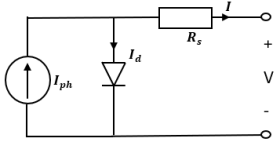
In general, a shunt current generator with a diode can be used to represent the electrical circuit of an ideal photovoltaic cell (Figure 1)
[7]
J. S. Kumari and C. Sai Babu, «Mathematical Modeling and Simulation of Photovoltaic Cell using Matlab-Simulink Environment» International Journal of Electrical and Computer Engineering (IJECE), vol. 2, n° 11, pp. 26-34, 2012.
[8]
M. Premkumara, C. Kumarb and R. Sowmyac, «Mathematical Modelling of Solar Photovoltaic Cell/Panel/Array» Journal of Renewable Energy Development (IJRED), vol. 9, n° 11, pp. 7-22, 2020.
Figure 1. Electrical Representation of an Ideal Photovoltaic Cell.
By applying the node law, we obtain the current I.
(1)
where is the photocurrent and the diode current. Equations (2) and (3) give the expressions for Iph and Id, respectively
[9]
S. Mohammadnejad, A. Khalafi, S. M. Ahmadi, «Mathematical analysis of total-cross-tied photovoltaic array under partial shading condition and its comparison with other configurations» Solar Energy, vol. 113, pp. 501-511, 2016.
where: is the photocurrent in STC; ki is the short-circuit current at 298.5 K and 1000 W/m²; Is the saturation current of the junction diode; q, the elementary charge; G is the irradiation (W/m2); kB, represents the Boltzmann constant; n, is the ideality factor of the diode; T, is the junction temperatureand V the output voltage
[7]
J. S. Kumari and C. Sai Babu, «Mathematical Modeling and Simulation of Photovoltaic Cell using Matlab-Simulink Environment» International Journal of Electrical and Computer Engineering (IJECE), vol. 2, n° 11, pp. 26-34, 2012.
[8]
M. Premkumara, C. Kumarb and R. Sowmyac, «Mathematical Modelling of Solar Photovoltaic Cell/Panel/Array» Journal of Renewable Energy Development (IJRED), vol. 9, n° 11, pp. 7-22, 2020.
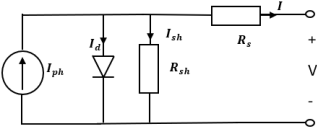
When a parallel resistance () is added to the previous circuit, we obtain the electrical model of a photovoltaic cell (Figure 2).
[10]
R. Prakash, S. Singh, «Designing and Modelling of Solar Photovoltaic Cell and Array» Journal of Electrical and Electronics Engineering (IOSR-JEEE), vol. 11, n° 12, pp. 35-40, 2016.
[11]
F. Oudiai, K. Menouer, A. Hadj arab and R. Zirmi, « Commande MPPT et Contrôle d’un Système Photovoltaïque par Incrément de la Conductance,» 2nd International Seminar on Fossil, New and Renewable Energy, pp. 1-7, 2019.
[12]
X. H. Nguyen and M. P. Nguyen, «Mathematical modeling of photovoltaic cell/module/arrays with tags in Matlab/Simulink» Environmental Systems research, vol. 4, n° 24, pp. 1-13, 2015.
To power a receptor, it is necessary to connect the cells in series (NS) and in parallel (NP) in order to increase the output voltage and current. The current delivered by a photovoltaic solar module is given by equation (8)
[8]
M. Premkumara, C. Kumarb and R. Sowmyac, «Mathematical Modelling of Solar Photovoltaic Cell/Panel/Array» Journal of Renewable Energy Development (IJRED), vol. 9, n° 11, pp. 7-22, 2020.
F. Oudiai, K. Menouer, A. Hadj arab and R. Zirmi, « Commande MPPT et Contrôle d’un Système Photovoltaïque par Incrément de la Conductance,» 2nd International Seminar on Fossil, New and Renewable Energy, pp. 1-7, 2019.
[12]
X. H. Nguyen and M. P. Nguyen, «Mathematical modeling of photovoltaic cell/module/arrays with tags in Matlab/Simulink» Environmental Systems research, vol. 4, n° 24, pp. 1-13, 2015.
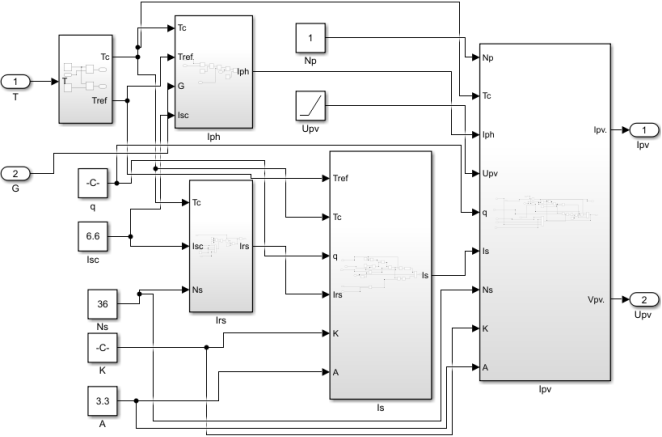
Using equation (8), we construct the MATLAB/Simulink model of a solar module (Figure 3). In this model, we have the input parameters (sunshine and temperature) and the output parameters (voltage and current).
Figure 3. Representation of a Photovoltaic Solar Module in MATLAB/Simulink.
2.2. Presentation of Mono- and Polycrystalline Photovoltaic Cells
Silicon-based photovoltaic solar modules (monocrystalline and polycrystalline) are the most commonly used in photovoltaic systems in Burkina Faso. The Czochralski method is used to obtain monocrystalline silicon
[13]
S. C. P. S. Y. W. C. Y. Liang Jiang, «Comparison of Monocrystalline and Polycrystalline Solar Modules » chez IEEE 5th Information Technology and Mechatronics Engineering Conference, China, 2020.
[13]
. Polycrystalline silicon is obtained by melting and shaping the equipment in a quartz crucible
[14]
Sugianto, «Comparative Analysis of Solar Cell Efficiency between Monocrystalline and Polycrystalline» INTEK Jurnal Penelitian, vol. 7, n° 12, pp. 92-100, 2020.
HarvestChoice, « NASA-Power Daily Time Series » International Food Policy Research Institute, Washington, DC., and University of Minnesota, St. Paul, 27 01 2017.
O. Ayadia, R. Shadidc, A. Bani-Abdullahc, M. Alrbaib, M. Abu-Muallab, N. A. Balahb, «Experimental comparison between Monocrystalline, Polycrystalline, and Thin-film solar systems under sunny climatic conditions» Energy Reports, vol. 8, pp. 218-2030, 2022.
E. M. Galal, A. S. Abdel-Mawgoud, M. H. Hamed, and G. A. M. Ali, «The Performance of Polycrystalline and Monocrystalline Solar Modules Under the Climate Conditions of El-Kharga Oasis, New Valley Governorate, Egypt» International Journal of Thin Films Science and Technology, vol. 12, n° 13, pp. 207-215, 2023.
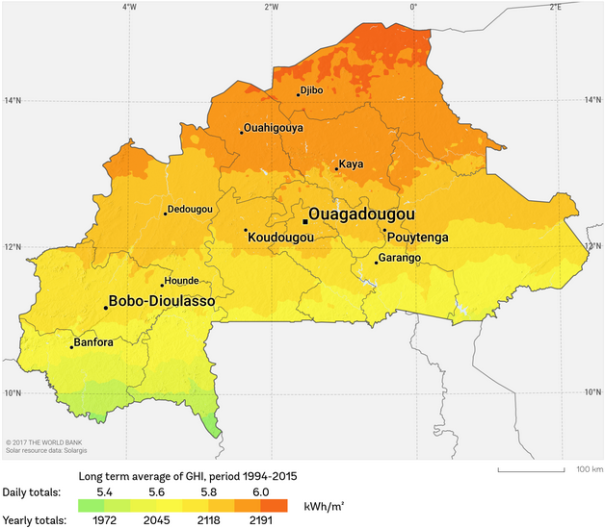
Koudougou is a city in Burkina Faso. It is located at a latitude of 12°15'04'' north and a longitude of 2°22'28'' west, 100 km from Ouagadougou. This site was chosen for experimentation because of its relatively high solar potential. Figure 4 shows the geographical location of the experimental site and the global irradiation of Burkina Faso.
Figure 4. Map of Global Horizontal Irradiation in Burkina Faso
[15]
HarvestChoice, « NASA-Power Daily Time Series » International Food Policy Research Institute, Washington, DC., and University of Minnesota, St. Paul, 27 01 2017.
For the experimental part, we used monocrystalline photovoltaic solar modules from the manufacturer Yaki Electric (M100) and polycrystalline modules from the manufacturer Copex Solar (model P100), each with a standard capacity of 100 W. We also used multimeters and temperature probes for data collection. In the simulation part, MATLAB/Simulink simulation software was used. The main characteristics of the panels used are given in Table 1.
Table 1. Characteristics of Monocrystalline and Polycrystalline Modules.
Characteristics
Monocrystalline
Polycrystalline
Maximum power (Pmax)
100Wp
100Wp
Voltage (Vmp)
18.1V
18.2V
Current (Imp)
5.9A
6.04A
Open circuit voltage (Voc)
21.7V
21.7V
Short-circuit current (Isc)
6.6A
6.65A
2.5. Data Collection Methods
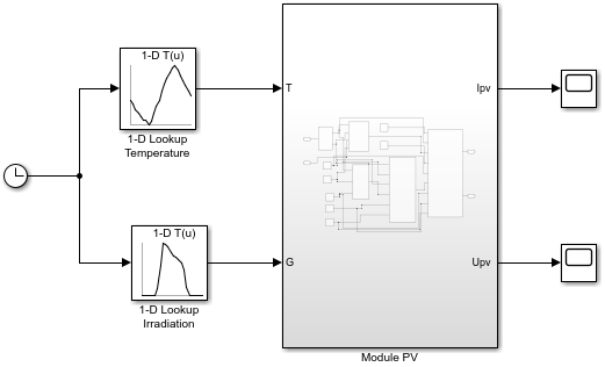
The experiment was conducted in Koudougou during October 2024 for a period of 30 days. Data was collected at 15-minute intervals between 6 a.m. to 6 p.m., under daily weather conditions using multimeters and thermocouples. The data collected included irradiation, temperature, current intensity and voltage. In the MATLAB/Simulink environment, we considered sunlight and ambient temperature as input parameters. Electric current intensity and voltage were considered as output parameters. The MATLAB/Simulink model is shown in Figure 5.
Figure 5. Representation of the Simulation Model in MATLAB/Simulink.
3. Results and Discussions
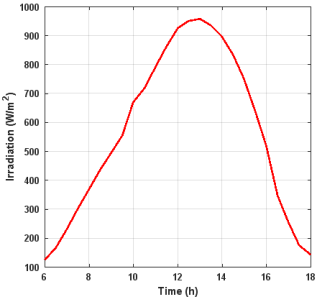
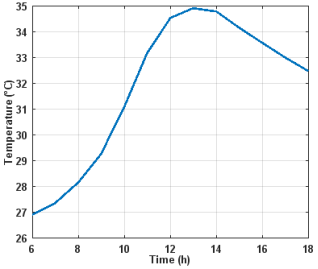
Figures 6 and 7 shows the curves for irradiation and average daily temperature for the month of October 2024. The data was collected between 6 a.m. and 6 p.m.
Figure 7. Temperature Curve as a Function of Time.
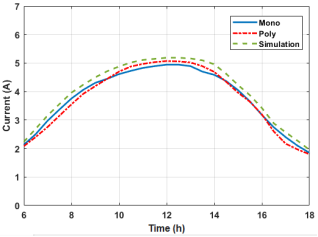
In our simulation model, we used the daily average of experimentally obtained irradiation and ambient temperatures. The experimental and simulation results are illustrated in Figures 8 and 9.
Figure 8 shows the evolution of current over time for monocrystalline and polycrystalline modules and the results obtained from the simulation. It can be seen that during periods of low sunlight, from 6 a.m. to 9:45 a.m. and from 4 p.m. to 6 p.m., the current produced by monocrystalline modules is slightly higher than that produced by polycrystalline modules. However, during the period of strong sunlight, from 9:45 a.m. to 4 p.m., current peaks are observed. The peak current produced by polycrystalline modules is slightly higher than that produced by monocrystalline modules. This period also corresponds to the period when irradiation and ambient temperature are high. We can therefore say that the current peaks observed during this period are due to high solar radiation. In addition, the rise in ambient temperature during this period has a negative influence on the current delivered by monocrystalline modules compared to that delivered by polycrystalline modules.
Figure 8. Evolution of Current Over Time for Different Types of Modules.
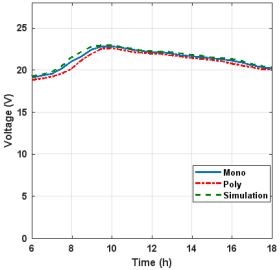
The results of the evolution of voltage over time for monocrystalline and polycrystalline modules obtained from the simulation are shown in Figure 9. In general, we can see that the voltage at the terminals of monocrystalline modules is slightly higher than that at the terminals of polycrystalline modules. The simulation results show us that the voltage varies in the same way as that obtained experimentally.
We can see that the voltage peaks occur between 9am and 11am. These peaks may be due to the fact that during this period, we have fairly strong irradiation and a relatively lower ambient temperature.
Figure 9. Voltage Evolution Over Time for Different Types of Modules.
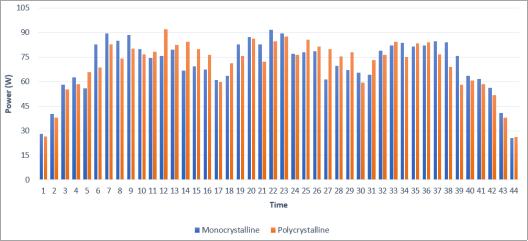
Based on the currents delivered and the voltages at the terminals of the different types of modules, we obtain the average instantaneous power outputs for the month of October 2024 (Figure 10). In general, we note that the power values generated by each of the modules are relatively low at the beginning and end of the day. This is probably due to the low irradiation during these periods of the day.
In the middle of the day, there are often dips in module production. This period very often coincides with periods of high temperatures. Thus, temperature has a negative influence on the production of monocrystalline and polycrystalline modules.
Figure 10. Instantaneous Daily Power Output of Monocrystalline and Polycrystalline Modules.
We can therefore say that the ambient temperature in the city of Koudougou has a negative influence on the production of monocrystalline and polycrystalline silicon-based modules. However, this influence is more pronounced on monocrystalline modules than on polycrystalline ones. The average daily power obtained during sunny periods shows that monocrystalline modules perform slightly better than polycrystalline modules.
These results are virtually identical to those obtained by
[16]
O. Ayadia, R. Shadidc, A. Bani-Abdullahc, M. Alrbaib, M. Abu-Muallab, N. A. Balahb, «Experimental comparison between Monocrystalline, Polycrystalline, and Thin-film solar systems under sunny climatic conditions» Energy Reports, vol. 8, pp. 218-2030, 2022.
E. M. Galal, A. S. Abdel-Mawgoud, M. H. Hamed, and G. A. M. Ali, «The Performance of Polycrystalline and Monocrystalline Solar Modules Under the Climate Conditions of El-Kharga Oasis, New Valley Governorate, Egypt» International Journal of Thin Films Science and Technology, vol. 12, n° 13, pp. 207-215, 2023.
F. Hidayanti «The Effect of Monocrystalline and Polycrystalline Material Structure on Solar Cell Performance» International Journal of Emerging Trends in Engineering Research, vol. 8, n° 17, pp. 3420-3427, 2020.
M. Ray, M. F. Kabir, M. Raihan, A. B. M. N. Bhuiyan, T. Akand and N. Mohammad, «Performance evaluation of monocrystalline and polycrystalline based» International Journal of Energy and Environmental Engineering, vol. 10, n° 13, pp. 1-13, 2023.
for the case of Dhaka (Bangladesh) for a solar tracking system. Looking ahead, it would be important to consider the influence of humidity, wind, and dust on the performance of both types of modules. Furthermore, it would be necessary to conduct the same study in other cities in Burkina Faso.
4. Conclusion
At the end of our study, we can say that the performance of monocrystalline and polycrystalline PV modules evolves in the same direction as the evolution of solar radiation in the city of Koudougou. However, ambient temperature has a negative impact on output currents and terminal voltages, with a more significant effect on monocrystalline modules than on polycrystalline modules. Furthermore, the evaluation of average power shows that polycrystalline modules perform slightly less well than monocrystalline modules. In general, given the climate in the city of Koudougou, monocrystalline modules perform better than polycrystalline modules. It would also be necessary to conduct an economic study on the two types of modules in order to determine, based on value for money, the most appropriate module technology to enable widespread deployment of these modules in Koudougou.
Abbreviations
Imp
Maximum Power Current
ISC
Short-Circuit Current
PV
Photovoltaic
Pmax
Maximum Power
STC
Standard Test Conditions
V (OC)
Open Circuit Voltage
Vmp
Maximum Power Voltage
Author Contributions
Eric Korsaga: Conceptualisation, Data curation, Formal analysis, Investigation, Methodology, Resources, Writing – original draft, Writing – review & editing
The data is available from the corresponding author upon reasonable request.
Conflicts of Interest
The authors declare no conflicts of interest.
References
[1]
M. Waongo, Z. Koalaga et F. Zougmore, «A guideline for sizing Photovoltaic panels across different climatic zones in Burkina Faso» IOP science (International Symposium on Electrical Arc and Thermal Plasmas in Africa (ISAPA)), vol. 29, pp. 1-15, 2012.
K. Badza, M. Sawadogo, Y. M. Soro, «Environemntal impacts of a stand-alone photovoltaic system in sub-saharan Africa: A case study in Burkina Faso» ScienceDirect (Heliyon), vol. 10, pp. 1-11, 2024.
D. A Quansah, M. S Adaramola, L. D Mensaha, «Solar Photovoltaics in sub-Saharan Africa – Addressing Barriers, Unlocking Potential» ScienceDirect (Energy procedia), 1st Energy Economics Iberian Conference, EEIC, vol. 106, pp. 97-110, 2016.
E. Korsaga, D. Bonkoungou, T. T. Guingané, S. LDG Tassembédo, H. Savadogo, Z. Koalaga “Influence of Temperature and Solar Irradiation on the Performance of Electrochemical Batteries in an Autonomous Photovoltaic System in Burkina Faso,” Energy and Power Engineering, vol. 17, no. 10, pp. 324-337, 2025.
S. Daher, J. Schmid, and F. L. M. Antunes, «Multilevel Inverter Topologies for stand-alone PV systems» IEEE transactions on industrial electronics, vol. 55, n° 17, pp. 2703-2712, 2008.
[6]
J. Suryakumari, G. Sahiti, G. Sudhakar, «Analysis and Simulation Of Perturb and Observe Mppt» International Journal of Engineering Research and Applications (IJERA), vol. 3, n° 14, pp. 1662-1668, 2013.
[7]
J. S. Kumari and C. Sai Babu, «Mathematical Modeling and Simulation of Photovoltaic Cell using Matlab-Simulink Environment» International Journal of Electrical and Computer Engineering (IJECE), vol. 2, n° 11, pp. 26-34, 2012.
[8]
M. Premkumara, C. Kumarb and R. Sowmyac, «Mathematical Modelling of Solar Photovoltaic Cell/Panel/Array» Journal of Renewable Energy Development (IJRED), vol. 9, n° 11, pp. 7-22, 2020.
S. Mohammadnejad, A. Khalafi, S. M. Ahmadi, «Mathematical analysis of total-cross-tied photovoltaic array under partial shading condition and its comparison with other configurations» Solar Energy, vol. 113, pp. 501-511, 2016.
R. Prakash, S. Singh, «Designing and Modelling of Solar Photovoltaic Cell and Array» Journal of Electrical and Electronics Engineering (IOSR-JEEE), vol. 11, n° 12, pp. 35-40, 2016.
[11]
F. Oudiai, K. Menouer, A. Hadj arab and R. Zirmi, « Commande MPPT et Contrôle d’un Système Photovoltaïque par Incrément de la Conductance,» 2nd International Seminar on Fossil, New and Renewable Energy, pp. 1-7, 2019.
[12]
X. H. Nguyen and M. P. Nguyen, «Mathematical modeling of photovoltaic cell/module/arrays with tags in Matlab/Simulink» Environmental Systems research, vol. 4, n° 24, pp. 1-13, 2015.
S. C. P. S. Y. W. C. Y. Liang Jiang, «Comparison of Monocrystalline and Polycrystalline Solar Modules » chez IEEE 5th Information Technology and Mechatronics Engineering Conference, China, 2020.
[14]
Sugianto, «Comparative Analysis of Solar Cell Efficiency between Monocrystalline and Polycrystalline» INTEK Jurnal Penelitian, vol. 7, n° 12, pp. 92-100, 2020.
HarvestChoice, « NASA-Power Daily Time Series » International Food Policy Research Institute, Washington, DC., and University of Minnesota, St. Paul, 27 01 2017.
O. Ayadia, R. Shadidc, A. Bani-Abdullahc, M. Alrbaib, M. Abu-Muallab, N. A. Balahb, «Experimental comparison between Monocrystalline, Polycrystalline, and Thin-film solar systems under sunny climatic conditions» Energy Reports, vol. 8, pp. 218-2030, 2022.
E. M. Galal, A. S. Abdel-Mawgoud, M. H. Hamed, and G. A. M. Ali, «The Performance of Polycrystalline and Monocrystalline Solar Modules Under the Climate Conditions of El-Kharga Oasis, New Valley Governorate, Egypt» International Journal of Thin Films Science and Technology, vol. 12, n° 13, pp. 207-215, 2023.
F. Hidayanti «The Effect of Monocrystalline and Polycrystalline Material Structure on Solar Cell Performance» International Journal of Emerging Trends in Engineering Research, vol. 8, n° 17, pp. 3420-3427, 2020.
M. Ray, M. F. Kabir, M. Raihan, A. B. M. N. Bhuiyan, T. Akand and N. Mohammad, «Performance evaluation of monocrystalline and polycrystalline based» International Journal of Energy and Environmental Engineering, vol. 10, n° 13, pp. 1-13, 2023.
Korsaga, E., Bado, N., Bonkoungou, D., Guingane, T. T., Savadogo, H., et al. (2026). Influence of Climatic Parameters on the Performance of Polycrystalline and Monocrystalline Silicon Photovoltaic Solar Modules: The Case of the City of Koudougou. International Journal of Sustainable and Green Energy, 15(1), 14-22. https://doi.org/10.11648/j.ijsge.20261501.12
Korsaga, E.; Bado, N.; Bonkoungou, D.; Guingane, T. T.; Savadogo, H., et al. Influence of Climatic Parameters on the Performance of Polycrystalline and Monocrystalline Silicon Photovoltaic Solar Modules: The Case of the City of Koudougou. Int. J. Sustain. Green Energy2026, 15(1), 14-22. doi: 10.11648/j.ijsge.20261501.12
Korsaga E, Bado N, Bonkoungou D, Guingane TT, Savadogo H, et al. Influence of Climatic Parameters on the Performance of Polycrystalline and Monocrystalline Silicon Photovoltaic Solar Modules: The Case of the City of Koudougou. Int J Sustain Green Energy. 2026;15(1):14-22. doi: 10.11648/j.ijsge.20261501.12
@article{10.11648/j.ijsge.20261501.12,
author = {Eric Korsaga and Nebon Bado and Dominique Bonkoungou and Toussaint Tilado Guingane and Haidara Savadogo and Sidpendyaolba Sosthene Ldg Tassembedo and Zacharie Koalaga},
title = {Influence of Climatic Parameters on the Performance of Polycrystalline and Monocrystalline Silicon Photovoltaic Solar Modules: The Case of the City of Koudougou},
journal = {International Journal of Sustainable and Green Energy},
volume = {15},
number = {1},
pages = {14-22},
doi = {10.11648/j.ijsge.20261501.12},
url = {https://doi.org/10.11648/j.ijsge.20261501.12},
eprint = {https://article.sciencepublishinggroup.com/pdf/10.11648.j.ijsge.20261501.12},
abstract = {Monocrystalline and polycrystalline silicon-based modules are commonly used in Burkina Faso, particularly in the city of Koudougou, to generate electricity. However, climatic parameters affect the performance of these modules. It is therefore necessary to conduct a comparative study between polycrystalline and monocrystalline silicon-based photovoltaic solar modules. The objective of this work is therefore to determine the module best suited to the city of Koudougou's climatic context. In this study, climatic parameters such as sunshine and temperature were considered. Thus, based on the mathematical model of a photovoltaic module, a simulation was carried out in the MATLAB/Simulink environment an experimental study of the two types of modules was conducted. The results obtained after the simulations and experiments were compared. Analysis of the results for the two module technologies shows that during the period of the day when the temperature is high, the polycrystalline silicon-based module performs better than the monocrystalline silicon-based module. However, during periods when the temperature is lower, the monocrystalline module performs better than the polycrystalline module. Considering the average daily power output for October 2024, it appears that the monocrystalline silicon-based module performs better than the polycrystalline silicon-based module. In general, monocrystalline modules offer better technical performance than polycrystalline modules in the climate of the city of Koudougou.},
year = {2026}
}
TY - JOUR
T1 - Influence of Climatic Parameters on the Performance of Polycrystalline and Monocrystalline Silicon Photovoltaic Solar Modules: The Case of the City of Koudougou
AU - Eric Korsaga
AU - Nebon Bado
AU - Dominique Bonkoungou
AU - Toussaint Tilado Guingane
AU - Haidara Savadogo
AU - Sidpendyaolba Sosthene Ldg Tassembedo
AU - Zacharie Koalaga
Y1 - 2026/01/19
PY - 2026
N1 - https://doi.org/10.11648/j.ijsge.20261501.12
DO - 10.11648/j.ijsge.20261501.12
T2 - International Journal of Sustainable and Green Energy
JF - International Journal of Sustainable and Green Energy
JO - International Journal of Sustainable and Green Energy
SP - 14
EP - 22
PB - Science Publishing Group
SN - 2575-1549
UR - https://doi.org/10.11648/j.ijsge.20261501.12
AB - Monocrystalline and polycrystalline silicon-based modules are commonly used in Burkina Faso, particularly in the city of Koudougou, to generate electricity. However, climatic parameters affect the performance of these modules. It is therefore necessary to conduct a comparative study between polycrystalline and monocrystalline silicon-based photovoltaic solar modules. The objective of this work is therefore to determine the module best suited to the city of Koudougou's climatic context. In this study, climatic parameters such as sunshine and temperature were considered. Thus, based on the mathematical model of a photovoltaic module, a simulation was carried out in the MATLAB/Simulink environment an experimental study of the two types of modules was conducted. The results obtained after the simulations and experiments were compared. Analysis of the results for the two module technologies shows that during the period of the day when the temperature is high, the polycrystalline silicon-based module performs better than the monocrystalline silicon-based module. However, during periods when the temperature is lower, the monocrystalline module performs better than the polycrystalline module. Considering the average daily power output for October 2024, it appears that the monocrystalline silicon-based module performs better than the polycrystalline silicon-based module. In general, monocrystalline modules offer better technical performance than polycrystalline modules in the climate of the city of Koudougou.
VL - 15
IS - 1
ER -
Department of Physics, Joseph KI-ZERBO University, Ouagadougou, Burkina Faso
Biography:
Eric Korsaga is a lecturer in the Department of Physics at Joseph Ki-Zerbo University (Burkina Faso). He defended his PhD in Semiconductor Physics, more specifically on photovoltaic energy storage, on 18 January 2019. He was promoted to the rank of assistant professor by CAMES in 2023.
Department of Physics, Joseph KI-ZERBO University, Ouagadougou, Burkina Faso
Biography:
Nebon Bado is a lecturer in the Department of Physics at Joseph Ki-Zerbo University (Burkina Faso). He defended his PhD in Atmospheric Physics and Environment, more specifically aerosols and their impact on solar energy with, on 4 April 2019. He was promoted to the rank of assistant professor by CAMES in 2023.

Department of Physics, Joseph KI-ZERBO University, Ouagadougou, Burkina Faso;Department of Science and Technology, Thomas SANKARA University, Ouagadougou, Burkina Faso
Biography:
Dominique Bonkoungou obtained his PhD, under joint supervision, from the University of Ouagadougou (Burkina Faso) and the University of Yaounde I (Cameroon) in January 2016. He is currently a senior lecturer in electrical engineering and renewable energy at the Faculty of Science and Technology, Thomas SANKARA University. He has taught applied mechanics, optics, electronics and thermodynamics at Thomas SANKARA University. His research focuses on the modelling, control and design of power systems, renewable energy systems and smart systems.

Department of Physics, Joseph KI-ZERBO University, Ouagadougou, Burkina Faso;Department of Science and Technology, Thomas SANKARA University, Ouagadougou, Burkina Faso
Biography:
Toussaint Tilado Guingane, PhD degree in Applied Physics for Renewable Energy, Joseph Ki-Zerbo University, Ouagadougou, May 2018. Associate Professor at Thomas Sankara University, I work in several areas of expertise in physics. I specialise in semiconductor physics, renewable energy, analysis of physical systems data, modelling and model validation. In July 2025, I was promoted to the rank of Associate Professor in Semiconductor Physics/Energy. In September 2021, I was promoted to the rank of Assistant Professor in Semiconductor Physics/Energy. From 2016 to 2023, I contributed to the writing of about fifteen articles. From 2022 to 2023, I obtained certificates in data analysis using R and Python software. From 2022 to 2025, I am supervising nine Master's students in physics.

Department of Physics, Joseph KI-ZERBO University, Ouagadougou, Burkina Faso
Biography:
Haidara Savadogo is a PhD student at Joseph Ki-Zerbo University. His research focuses on energy storage, with a particular interest in optimising energy systems. He holds a Master's degree in applied physics, specialising in energy, from the same university, with a specialisation in. In addition to his research, he has a keen interest in data science and its applications in modelling and analysis. He has also participated in several international conferences on various topics and is passionate about scientific research and innovation. He is also a secondary school teacher.

Department of Physics, Joseph KI-ZERBO University, Ouagadougou, Burkina Faso
Biography:
Sidpendyaolba Sosthene Ldg Tassembedo is a lecturer and researcher at Joseph KI-ZERBO University. He obtained his PhD in 2019 at Joseph KI-ZERBO University, specialising in photovoltaic solar energy. Dr. Tassembedo is a member of IEEE-BF and the West African Physics Society. He is an expert with the National Electrotechnical Commission and has also served as a reviewer for several scientific journals and conferences.

Department of Physics, Joseph KI-ZERBO University, Ouagadougou, Burkina Faso
Biography:
Zacharie Koalaga holds a PhD in Electrotechnics from Blaise Pascal University, France (1991). He is a Full Professor in Electronics, Electrotechnics, and Photovoltaics at UJKZ's Department of Physics and has been Director of the Laboratory of Materials and Environment (LAME) since 2020. He previously served as President of the Scientific Council for ESUP-Jeunesse and IFIC-AUF in Tunis, and as Director of UJKZ's Institute of Open and Distance Learning and the ISGE-BF Institute. His research focuses on electrical arcs, plasmas, and photovoltaic systems. He has supervised 14 PhD theses and over 50 Master's dissertations. Prof. Koalaga coordinates several research projects and conferences, including the RAMSES Network and ISAPA Symposium, and serves as Scientific Editor of JITIPEE. He is also a member of professional organisations such as IEEE.

Korsaga, E., Bado, N., Bonkoungou, D., Guingane, T. T., Savadogo, H., et al. (2026). Influence of Climatic Parameters on the Performance of Polycrystalline and Monocrystalline Silicon Photovoltaic Solar Modules: The Case of the City of Koudougou. International Journal of Sustainable and Green Energy, 15(1), 14-22. https://doi.org/10.11648/j.ijsge.20261501.12
Korsaga, E.; Bado, N.; Bonkoungou, D.; Guingane, T. T.; Savadogo, H., et al. Influence of Climatic Parameters on the Performance of Polycrystalline and Monocrystalline Silicon Photovoltaic Solar Modules: The Case of the City of Koudougou. Int. J. Sustain. Green Energy2026, 15(1), 14-22. doi: 10.11648/j.ijsge.20261501.12
Korsaga E, Bado N, Bonkoungou D, Guingane TT, Savadogo H, et al. Influence of Climatic Parameters on the Performance of Polycrystalline and Monocrystalline Silicon Photovoltaic Solar Modules: The Case of the City of Koudougou. Int J Sustain Green Energy. 2026;15(1):14-22. doi: 10.11648/j.ijsge.20261501.12
@article{10.11648/j.ijsge.20261501.12,
author = {Eric Korsaga and Nebon Bado and Dominique Bonkoungou and Toussaint Tilado Guingane and Haidara Savadogo and Sidpendyaolba Sosthene Ldg Tassembedo and Zacharie Koalaga},
title = {Influence of Climatic Parameters on the Performance of Polycrystalline and Monocrystalline Silicon Photovoltaic Solar Modules: The Case of the City of Koudougou},
journal = {International Journal of Sustainable and Green Energy},
volume = {15},
number = {1},
pages = {14-22},
doi = {10.11648/j.ijsge.20261501.12},
url = {https://doi.org/10.11648/j.ijsge.20261501.12},
eprint = {https://article.sciencepublishinggroup.com/pdf/10.11648.j.ijsge.20261501.12},
abstract = {Monocrystalline and polycrystalline silicon-based modules are commonly used in Burkina Faso, particularly in the city of Koudougou, to generate electricity. However, climatic parameters affect the performance of these modules. It is therefore necessary to conduct a comparative study between polycrystalline and monocrystalline silicon-based photovoltaic solar modules. The objective of this work is therefore to determine the module best suited to the city of Koudougou's climatic context. In this study, climatic parameters such as sunshine and temperature were considered. Thus, based on the mathematical model of a photovoltaic module, a simulation was carried out in the MATLAB/Simulink environment an experimental study of the two types of modules was conducted. The results obtained after the simulations and experiments were compared. Analysis of the results for the two module technologies shows that during the period of the day when the temperature is high, the polycrystalline silicon-based module performs better than the monocrystalline silicon-based module. However, during periods when the temperature is lower, the monocrystalline module performs better than the polycrystalline module. Considering the average daily power output for October 2024, it appears that the monocrystalline silicon-based module performs better than the polycrystalline silicon-based module. In general, monocrystalline modules offer better technical performance than polycrystalline modules in the climate of the city of Koudougou.},
year = {2026}
}
TY - JOUR
T1 - Influence of Climatic Parameters on the Performance of Polycrystalline and Monocrystalline Silicon Photovoltaic Solar Modules: The Case of the City of Koudougou
AU - Eric Korsaga
AU - Nebon Bado
AU - Dominique Bonkoungou
AU - Toussaint Tilado Guingane
AU - Haidara Savadogo
AU - Sidpendyaolba Sosthene Ldg Tassembedo
AU - Zacharie Koalaga
Y1 - 2026/01/19
PY - 2026
N1 - https://doi.org/10.11648/j.ijsge.20261501.12
DO - 10.11648/j.ijsge.20261501.12
T2 - International Journal of Sustainable and Green Energy
JF - International Journal of Sustainable and Green Energy
JO - International Journal of Sustainable and Green Energy
SP - 14
EP - 22
PB - Science Publishing Group
SN - 2575-1549
UR - https://doi.org/10.11648/j.ijsge.20261501.12
AB - Monocrystalline and polycrystalline silicon-based modules are commonly used in Burkina Faso, particularly in the city of Koudougou, to generate electricity. However, climatic parameters affect the performance of these modules. It is therefore necessary to conduct a comparative study between polycrystalline and monocrystalline silicon-based photovoltaic solar modules. The objective of this work is therefore to determine the module best suited to the city of Koudougou's climatic context. In this study, climatic parameters such as sunshine and temperature were considered. Thus, based on the mathematical model of a photovoltaic module, a simulation was carried out in the MATLAB/Simulink environment an experimental study of the two types of modules was conducted. The results obtained after the simulations and experiments were compared. Analysis of the results for the two module technologies shows that during the period of the day when the temperature is high, the polycrystalline silicon-based module performs better than the monocrystalline silicon-based module. However, during periods when the temperature is lower, the monocrystalline module performs better than the polycrystalline module. Considering the average daily power output for October 2024, it appears that the monocrystalline silicon-based module performs better than the polycrystalline silicon-based module. In general, monocrystalline modules offer better technical performance than polycrystalline modules in the climate of the city of Koudougou.
VL - 15
IS - 1
ER -